
Death Drones Sustaining Genocide: Made in China, Delivered by UAE, Smuggled via Ethiopia

Documenting Sudan
When the Sky Becomes a Threat |
Sudan 2026: Drone Strikes on Civilians
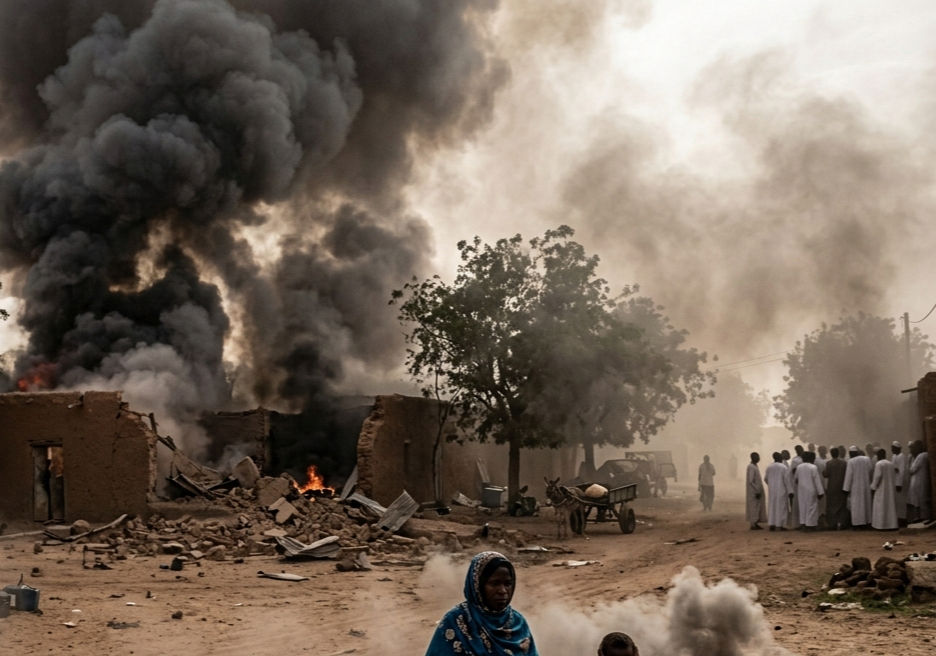
Drone War Sudan: Foreign Death Drones Sustaining Genocide
Before the war in Sudan began in April 2023, the Sudanese airspace was controlled by fighter jets of the Sudanese army (SAF). This changed with the outbreak of the war.
Since then, drones have been used by both warring parties, but the paramilitary Rapid Support Forces (RSF) dominate, employing drones systematically and offensively against civilian targets such as cities, infrastructure, hospitals, schools, and aid convoys. The Sudanese army also uses drones, primarily for large‑scale airstrikes on areas controlled by the RSF.
It is clearly evident that RSF drone attacks are far more systematic, frequent, and deadly in their targeting of the Sudanese civilian population than those carried out by their opponents. Their aim is to destabilize and destroy SAF‑held areas, and they also deliberately target locations where no SAF troops are stationed. Targets of these attacks include residential areas, markets, bus stations, hospitals, power stations, water facilities, schools, civilian transport convoys, and border towns in Chad. These attacks had no immediate military purpose. Through terror against civilians and the deliberate destruction of supply systems, these areas are meant to be rendered ungovernable. Drones enable the RSF to gain control over large territories.
Women and children: the most frequent victims of the drone attacks
UNICEF confirms that in Sudan, 78% of all child casualties in 2026 were caused by drone attacks. The Norwegian Refugee Council reports that almost 700 civilians have been killed by drone strikes since the beginning of the year, with the majority of the victims being women and children (UNICEF).
There is no comprehensive recording of deaths in Sudan, and current estimates exceed 400,000. As a result, there is also no realistic total number of people killed by drone strikes.
Made in China, delivered by the UAE, smuggled via Ethiopia
Drones that were identified in Sudan in 2026 indicate that they originated predominantly from the United Arab Emirates (UAE).
Sudanese activists, analysts, and members of the diaspora had already pointed to external drone support for the RSF from the UAE in 2024. More recently, however, the Sudanese army presented publicly accessible evidence showing photos of drone wreckage with visible serial numbers that are meant to prove that these drones originated from UAE stockpiles.
Independent analysts (OSINT, military experts, Middle East Eye) were able to identify the drones based on fuselage shape, sensors, wingspan, and engine placement. They are models of the Chinese CH series (CH‑3, CH‑4, CH‑5). The UAE possesses large stockpiles of these models. There are also indications that these drones are being smuggled through Ethiopian territory.
While Ethiopia is considered the most likely supply route for RSF drones, there are credible indications of additional routes through Chad and Libya. Analysts as well as UN experts point out that weapons and military equipment may move through several regional networks. However, the extent and reliability of these alternative routes are far less documented than the Ethiopian corridor.
Since 2024, recurring reports have circulated that drones are entering Sudan from the direction of Ethiopian border regions. The Sudanese government officially accuses Ethiopia of allowing drones to operate from Ethiopian territory. UN reports have also mentioned cross‑border drone attacks since 2024, without naming any states. Diaspora members, activists, and OSINT analysts have likewise documented patterns that indicate launches from within Ethiopia.
The role of the UAE
The United Arab Emirates have supported the Rapid Support Forces since the beginning of the war. According to the Sudanese government, numerous analysts, human rights organizations, and UN experts, this support amounts to complicity in severe war crimes up to and including genocide. Without the financial, logistical, and military backing provided by the Emirates — including weapons supplies, drones, and funding through gold‑smuggling networks — the RSF would not possess the military strength it has today.
The “kill box” of El Fasher: How foreign drones are enabling the genocide
What is most severe is not only the origin of the drones, but above all the scale of destruction they leave behind. Darfur in particular — a region with a bloody history with the RSF (then Janjaweed), where a genocide against ethnic minorities was committed — is once again suffering under RSF terror today, whether from the air or on the ground.
During the 18‑month siege of El Fasher in North Darfur — during which the RSF built a wall around the city to starve its population and which Nathaniel Raymond (HRL/Yale) described as a “kill box” — drones were used on a regular basis.
The words of those who had to witness the attacks on the city convey only a fraction of the horror and destruction caused by these drones: "It is no longer just simple shells; the drones are deliberately searching for the last places where people feel safe," a resident of El Fasher (anonymized) told Ayin Network. Refugee camps and mosques are not spared from drone attacks either. A volunteer from the Abu‑Shouk camp reported after an attack on the camp: "The drone attacked us, and when people gathered to help the wounded, it came back and attacked again. It circled above us and waited. We realized there was no escape."
In El Fasher, at least 60,000 people were recently killed in an RSF massacre, according to OSINT analyst and conflict researcher Thomas van Linge. An event which, according to van Linge, enters history as the largest single mass‑murder event of the 21st century.
In Darfur in particular, the RSF are targeting civilians, with ethnic minorities especially coming into the crosshairs of their atrocities.
Kordofan: The epicenter of the drone strikes
The use of military drones in Sudan, deployed as weapons, has increased dramatically. Even more than Darfur, the state of Kordofan has been affected by airstrikes and has become the epicenter of drone attacks. Here, drones have made civilian life impossible: in towns like Babanusa, heavy fighting has displaced almost the entire population — more than 150,000 people. According to the IOM, an estimated well over 1.5 to 2 million people have been displaced across Kordofan since the beginning of the war.
Kordofan and El Fasher make one thing clear: drones are not only weapons used against soldiers, but also tools for the large‑scale depopulation of entire regions. Although the RSF deploys drones as a systematic instrument of terror against civilians, the Sudanese army also contributes to the escalation by launching indiscriminate airstrikes on RSF‑controlled areas — often with no regard for civilian casualties.
The war in Sudan remains a brutal drone war against civilians, leaving almost no room for safety — while foreign death drones continue to enable the genocide.
*OSINT analysts work with publicly accessible information — such as photos, videos, satellite imagery, or databases — to verify military activities, weapons, or events in conflict zones.


Comments